01 Learn two letters
Can a decoder learn to tell two sensory cues apart after they pass through the fly’s brain model?
- 1. Baseline20 trials · updates off
- 2. Train60 trials · updates on
- 3. Evaluate40 fresh trials · weights frozen
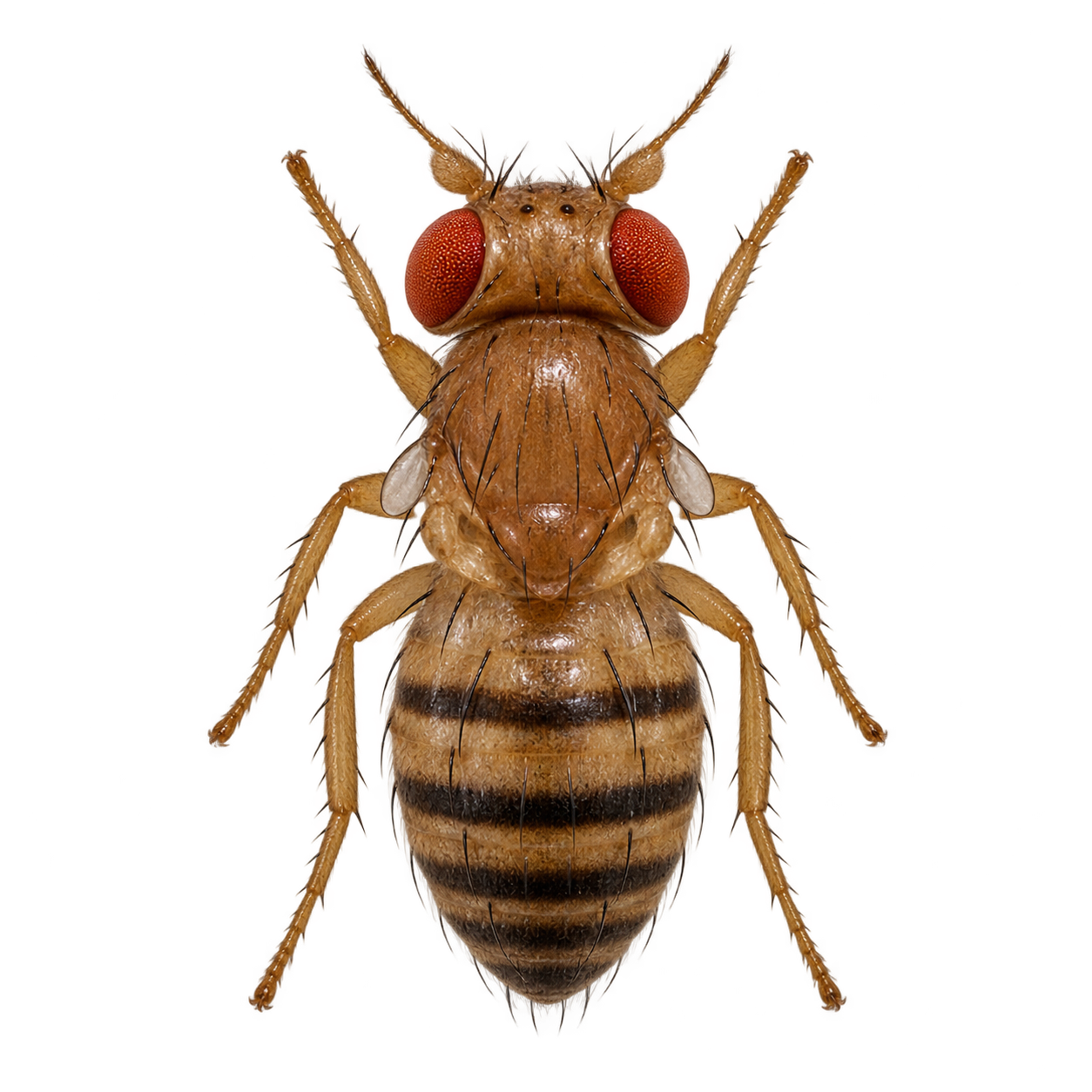
The decoder chooses the letter. An added controller moves the fly and presses that key; this is assisted typing, not learned navigation.
Unfiltered output
TXTOne explicit press per decision. Moving across a key never adds a letter.
02 Does training help?
Decoder has not been trained| Phase | Trained decoder | Untrained control | Weight updates |
|---|---|---|---|
| Baseline | — | — | Off |
| Training | — | — | On |
| Evaluation | — | — | Frozen |
Evaluation keeps the sensory cues available and freezes the decoder. This tests cue decoding, not phrase recall or language understanding.
03 Protocol & scientific limits
Task. Each trial presents T or O through a different artificial sensory input: 100 Hz Poisson drive to the annotated left or right LC4 + LPLC2 population. Each phase contains equally many of both letters, shuffled independently. A trial lasts 200 ms. Neural state starts at rest each trial; decoder weights persist.
What learns. A small logistic decoder uses seven downstream neural-rate features and a bias. It never receives the target letter, trial index, seed, or the directly stimulated neurons as features. Predictions are scored before any training update. All 139,255 neurons and 15,091,983 connected pairs remain in the fixed LIF model. No synaptic plasticity or dopamine learning has been added inside the connectome.
Test. After 20 baseline and 60 training trials, weights are locked for 40 evaluation trials with fresh sensory noise. A second decoder keeps its initial weights throughout and sees the same neural features. The 95% Wilson interval describes uncertainty across evaluation trials in this run. New seeds are simulation replicates of one anatomical connectome, not additional biological flies.
Interpretation. An ordinary rule that reads the cue directly could solve this task perfectly. The untrained control tests the effect of decoder training; it does not establish an advantage for biological wiring. Sequence memory, shuffled-connectome comparisons, and biologically grounded learning rules are further experiments. Training and evaluation outcomes remain visible to you, but evaluation outcomes never update the decoder.
Reproducibility. Export the seed, full protocol, connectome hashes, every target and prediction, neural features, and decoder weights. Reusing a seed reproduces a run in this implementation. Page loads default to 1× target speed; computation may run slower on your device.
Background: Shiu et al.’s sensorimotor model and connectome reservoir computing. The latter uses different neural dynamics and does not validate this task.