01 From copying to recall
Teach a short phrase, freeze the decoder, then let each generated letter become the next input. The fly’s wiring stays fixed; learning and six-step memory are added outside it.
to be or not to be18 characters · 7 symbols + learned END
- 1. Teach6 phrase presentations · fit decoder
- 2. Recall3 fresh rollouts · weights frozen
- 3. CompareRemove history / use symbols directly
- —
- —
- —
- —
- —
- —
Each slot stores neural activity. Cue labels are shown here for inspection.
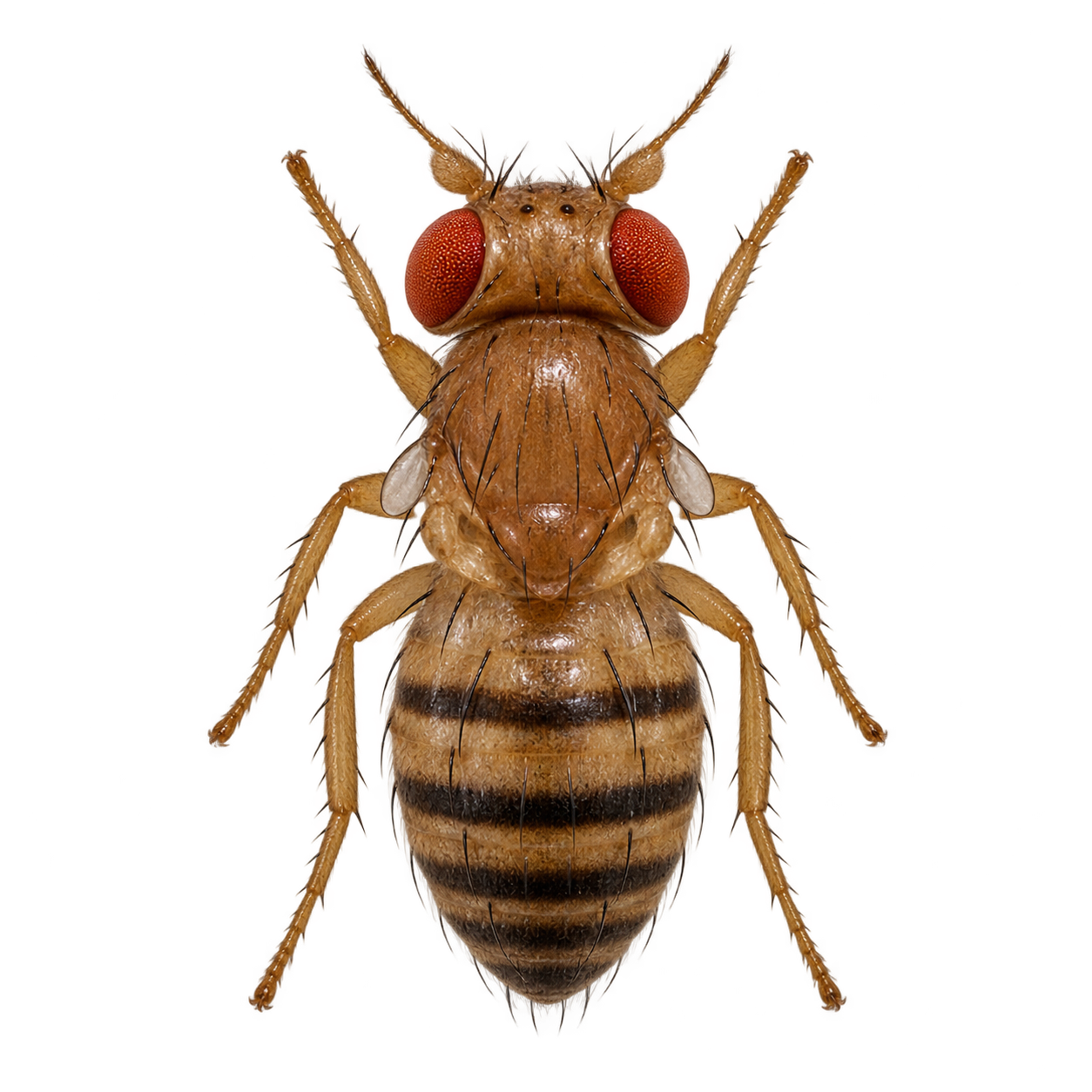
An added controller moves the fly to its chosen key. Presses are explicit, so repeats and mistakes are preserved. This tests a hybrid memory system, not learned navigation.
Raw recall
TXTTraining uses teaching cues. Recall receives START once, then only its own choices. END is a decision, not a key press.
02 Can it finish the phrase?
Decoder has not been fitted| System / run | Raw output | Stop | Edits | Exact? |
|---|---|---|---|---|
| Results appear here as each rollout finishes. | ||||
This is a memorization benchmark using seven symbols. Success would show recall by the combined system; the conventional comparison uses direct symbol memory.
03 Protocol & scientific limits
Training. Present the same 18-character phrase six times. At each step, the previous character is encoded through an arbitrary sensory stimulation pattern; START precedes the first character. Six recent neural responses form the added memory. This history length was chosen for the repeated “to be”: shorter context cannot distinguish continuing after its first occurrence from stopping after its second. A supervised multiclass decoder is fitted to predict the next character, including END after the phrase.
Neural encoder. All 139,255 neurons and 15,091,983 connected pairs remain in the fixed LIF model. Each cue lasts 200 ms, with neural state reset to rest; downstream spike counts exclude all directly stimulated cells. The six-response memory sits outside the connectome. These artificial inputs are a symbol code, not a claim that fly vision recognizes letters.
Autonomous recall. After fitting, the decoder is locked. Each of three fresh-noise rollouts starts with START, then feeds back its own prediction, including every error. The recall actor cannot see the phrase, expected next letter, position, or target length. It stops when it predicts END, or is marked truncated at a fixed 48-decision limit. Scoring happens separately.
Comparisons. The same neural decoder also runs with older memory slots removed. A conventional decoder learns from six steps of directly encoded symbols, using the same training examples and fitting method. Each comparison generates its own output. The symbol model is deterministic: its three displayed rollouts are identical repeats, not independent noise trials. It has fewer input features than the neural decoder, so this is not a comparison at matched capacity. Removing history is an intervention on the trained decoder, not a separately optimized memoryless model.
What success means. This tests reproduction of one short, repeatedly taught sequence over a restricted alphabet. It does not test new prose, language understanding, biological synaptic learning, or a special advantage of fly wiring. Seeds are simulation replicates of one anatomical connectome. Whole-play recall and biological learning remain separate experiments.
Reproducibility. Export the seed, stimulus codebook, protocol, connectome hashes, all neural observations and decisions, fitted parameters, and raw outputs. Every browser session computes a fresh run. New loads default to 1× target speed; actual computation may be slower.
Background: Shiu et al.’s sensorimotor model and connectome reservoir computing. The latter uses different neural dynamics and does not validate this particular recall system.